Websites That Think Back: What You Can Build When AI Meets the Web
What happens when AI meets web technology? Explore 7 practical ideas, from smarter search to talk-to-your-data dashboards, you can build today.

Websites That Think Back: What You Can Build When AI Meets the Web
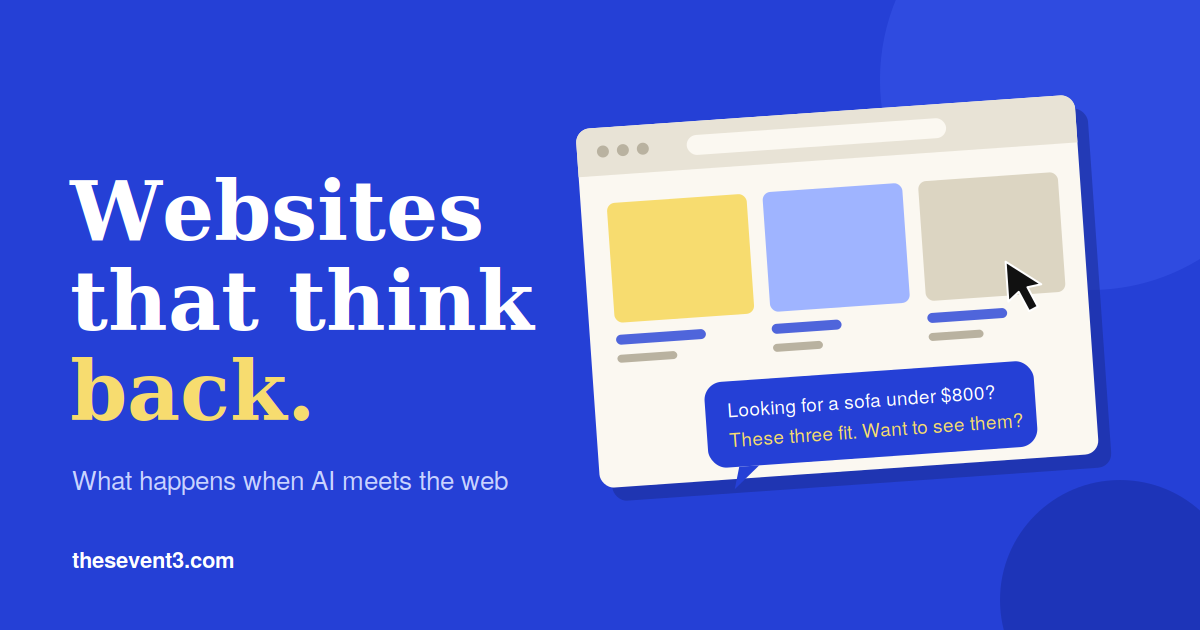
Last month I was trying to buy a sofa online. I opened a store, filtered by price, filtered by colour, scrolled through 200 products, and left without buying anything. The website had everything I needed. It just had no idea what I was actually looking for.
That gap is exactly where AI and web technology are about to change things.
For twenty years, websites have been very good at one thing: showing you information and waiting for you to figure it out. AI flips that. A site can now understand what you mean, not just what you typed. Here is what that makes possible, with ideas you can build today, not in some distant future.
1. Search that understands people, not keywords
Type "something warm for a small living room" into a normal search bar and you get nothing useful. With AI-powered semantic search, the site understands the idea behind your words and shows sofas, rugs and lamps that match the feeling.
Any site with a lot of content can use this: online stores, course platforms, recipe blogs, job boards, documentation pages. If people struggle to find things on your site, this is the first upgrade to consider.
2. A shop assistant that actually knows the catalogue
Most chatbots are annoying because they only know ten canned answers. A chatbot connected to your real product data, policies and stock is a different thing. It can say, "That model is out of stock, but this one is almost identical and ships tomorrow."
The trick is to keep it grounded in your own information so it doesn't make things up, and to let it hand over to a human when it should.
3. Pages that change for the person reading them
Imagine a landing page where the examples, the order of sections, and even the tone adjust to who is visiting. A first-time visitor sees a simple explanation. Someone returning for the third time sees pricing and a clear next step.
This used to need a whole team. Now a small developer team, or even one person, can build a reasonable version.
4. Content tools that save hours, not replace people
Think about what your team repeats every week: writing product descriptions, resizing images, translating pages, summarising long documents, tagging content. AI can draft these in seconds, and a person reviews and polishes.
The sites that do this well don't publish raw AI output. They use AI for the first 70 percent and keep a human for the part that makes it sound like them.
5. Forms and dashboards you can just talk to
Instead of clicking through five filters in a report, you ask: "Which products sold worst in the last 30 days, and why might that be?" The dashboard answers with a chart and a short explanation.
For small businesses that can't afford a data analyst, this is a big deal.
6. Accessibility that happens automatically
AI can write image descriptions for screen readers, generate captions for videos, simplify complicated text, and read pages aloud in natural voices. A web that more people can use is a better web, and these tools make it far cheaper to get there.
7. Prototypes in an afternoon
Designers and developers can now turn a rough idea into a working prototype very fast, then test it with real users before spending weeks on it. The skill is shifting from "can you build it" to "do you know what's worth building."
A few honest warnings
AI isn't magic, and a few things matter more than the technology itself:
- Accuracy. Always let AI work from your real data, and show people when an answer comes from AI.
- Privacy. Be clear about what you collect, and don't send sensitive customer data anywhere you wouldn't be comfortable explaining.
- Cost and speed. AI features cost money per use and can slow a page down. Start small and measure.
- The human touch. People still want to feel someone cares. Use AI to remove boring work, not to remove the personality of your brand.
Where to start
You don't need to rebuild your whole site. Pick one frustrating thing your visitors deal with. Maybe they can't find products, or your support inbox is overflowing with the same five questions. Fix that one thing with AI, watch how people respond, and build from there.
The web spent two decades learning to show us things. The next chapter is about websites that listen, understand, and help. The people who start experimenting now will be a long way ahead when everyone else catches up.
Hassan
Founder & Managing Director — Guiding creative direction, visual computing, and digital craftsmanship at SEVENT3 Global.
Discussion (0)
Loading comments...
Leave a Reply
Your email address will not be published. Required fields are marked *