Phones Get the Visits. Desktops Get the Time.
Phones now win most web visits, but desktops still win most of the time. Here’s what the 2026 State of Web report means for your website.

Phones Get the Visits. Desktops Get the Time.
Think about how you used the web yesterday. Maybe you opened a few sites on your phone while waiting in a queue, skimmed, and moved on. Then later, at your laptop, you sat down and actually did the thing: booked the trip, filled in the application, bought the sofa.
It turns out millions of us do exactly that. A new report called State of Web 2026, from the analytics company Sensor Tower, puts numbers on how the web is really being used right now. A few of them surprised me, and if you run a website, they are worth five minutes of your time.
A quick note before we start: this is the company's first edition of the report, and the figures come from its own data panel. Treat them as a strong signal about direction, not as exact measurements. Only the headline findings are public, and the full report sits behind a sign-up form.
We are spending less time on websites, not more
People around the world spent about 1.6 trillion hours on websites last year. That sounds enormous, until you learn it is actually a bit less than the year before.
The web is not dying. But attention is limited, and it is being split between apps, video, messaging and, increasingly, AI chats. For a website owner that means one thing: you have less time to make your point, so every page needs to earn its place.
Phones win on visits. Desktops win on depth.
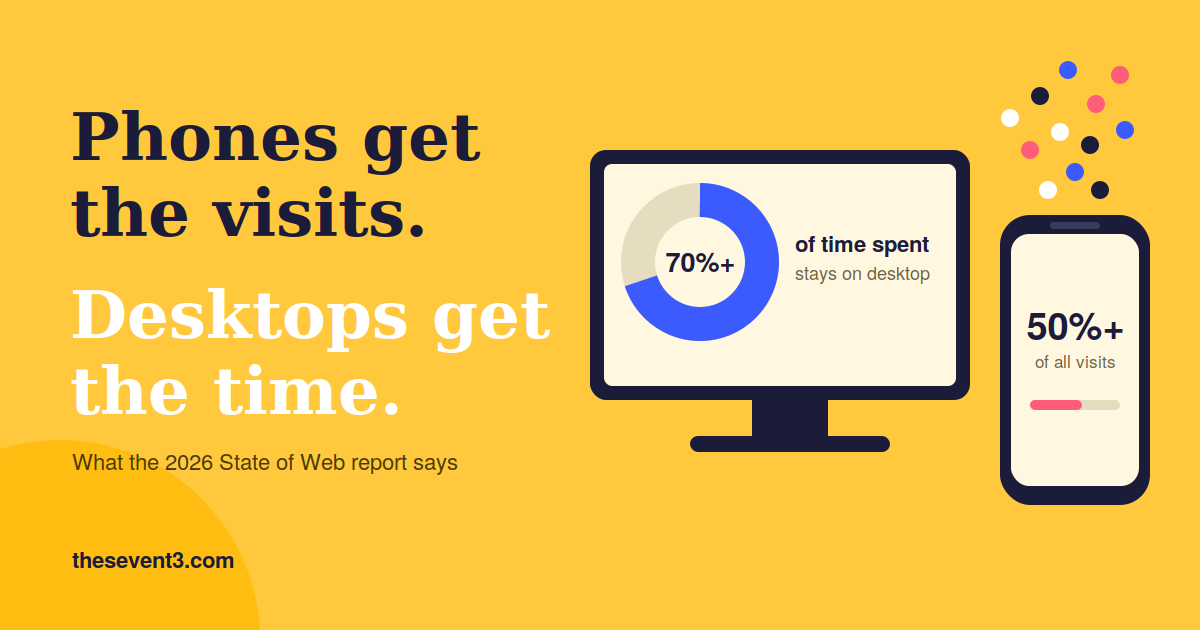
In the first quarter of 2026, phones passed the halfway mark for global web visits for the first time. More than half of all visits now happen on a mobile screen.
And yet, desktop still accounts for over 70 percent of the time people spend on the web. In plain words: people discover on their phones and commit on their computers.
What this means in practice:
- Your mobile page should answer one question quickly: what is this, and why should I care?
- Your desktop experience is where comparisons, long forms, checkouts and detailed reading happen. Don't ship a stretched-out phone layout and call it done.
- Make it easy to continue later. A "send this to my email" button or a saved cart can turn a phone visit into a desktop sale.
The internet still runs through a few front doors
Search and social media together account for roughly 2.4 trillion visits, and the report says Google and Meta dominate both traffic and engagement.
That is a lot of power sitting in very few hands. If most of your visitors arrive through one platform, a single algorithm change can empty your site overnight. The sites that stay calm through these changes usually have something that belongs to them: an email list, a community, or readers who simply type the address.
AI is booming, but it isn't sending much traffic yet
This is the part that made me stop scrolling. AI assistants were the fastest-growing category on the web in 2025, with traffic up 86 percent and time spent up 101 percent. ChatGPT became the sixth most visited website in the world.
But here is the twist. Visits that actually arrive on other websites from generative AI tools make up only 0.7 percent of all web traffic, and they are mostly clustered around software and education sites. Search is still the giant.
So people are spending more time inside AI tools, but those tools are not (yet) a big source of visitors for most sites. My reading is that there is no need to panic and no reason to ignore it either. Write pages that are clear, specific and trustworthy. That helps human readers today, and it is exactly the kind of content that AI tools are more likely to pick up and point to tomorrow.
What to do with all this
You don't need to rebuild your site. Start with five small checks:
- Open your site on your phone and see if a stranger would understand it in five seconds.
- Open it on a desktop and ask whether the deeper pages (pricing, details, forms) feel built for that bigger screen.
- Check where your visitors come from. If one source brings most of them, start building a second door.
- Add a way to come back: newsletter, WhatsApp channel, saved items, anything that is yours.
- Improve your best pages for clarity. Plain language, real examples, honest answers.
The bottom line
The web in 2026 is not shrinking and it is not being replaced. It is being used differently: quick looks on the phone, serious work on the desktop, and a growing chunk of curiosity going through AI. The websites that win will be the ones that respect how people actually behave, instead of how designers wish they would.
Source: Sensor Tower, State of Web 2026 (headline findings).
Hassan
Production Director — Guiding creative direction, visual computing, and digital craftsmanship at SEVENT3 Global.
Discussion (0)
Loading comments...
Leave a Reply
Your email address will not be published. Required fields are marked *